Pilzbeete: eines neue Art, Pilze im Gemüsegarten und Garten anzubauen
A New Way to Grow Mushrooms Outdoors, Create Productive Spaces and Make the Most of the Surrounding Resources
Creating a vegetable garden isn't just about growing vegetables. We can also grow mushrooms outdoors, working them into gardens, allotments, farms or productive spaces through what are known as mushroom beds (mushroom cultivation beds).
This growing technique makes it possible to create small productive ecosystems in which fungi transform organic matter into food, offering harvests for several years with relatively simple maintenance.
For anyone looking to move toward greater self-sufficiency and food sovereignty, for market growers wanting to diversify their production, or for landscaping and gardening professionals looking for new ways to add value to green spaces, mushroom cultivation beds open up a world of possibilities.
What Is a Mushroom Cultivation Bed?
Mushroom beds are outdoor growing spaces designed so that a species' mycelium can colonize an organic substrate and, once conditions are favorable, produce mushrooms.
Unlike conventional indoor mushroom growing, here we're not trying to fully control the environment. We work with the natural rhythms of temperature, humidity and seasonality, designing the crop so the fungus can develop under these conditions.
The result is a mushroom production system that's fully integrated into its surroundings.
A cultivation bed can be part of a vegetable garden, sit beneath trees, occupy an underused corner of the yard, or become part of a productive landscaping project. With good design, the same space can combine plants, fungi and other elements of the ecosystem, generating different functions and yields.

From the Conventional Vegetable Garden to the Fungal Garden
Traditionally, when we think of a vegetable garden we picture raised beds growing vegetables. But a productive system can go much further than that.
Mushrooms let us make use of lignocellulosic materials, such as straw, wood chips, leaf litter and other plant waste, turning them into growing substrate.
This adds a new dimension to how we design agricultural spaces: growing plants on the surface and mushrooms in the substrate.
It's a way of making use of different layers of a space while, at the same time, bringing fungi into more circular production systems.
Some species can also provide a seasonal harvest that complements the vegetable garden. When certain vegetable crops slow down, mushrooms can fill that gap in the production calendar. Field trials have also shown that introducing mycelium into a garden encourages greater root development in nearby plants, resulting in healthier, more vigorous plants with greater productive potential.
Designing the Crop: Incubation and Fruiting
For a cultivation bed to work, it isn't enough to just add mycelium to a pile of substrate. You need to understand what the fungus needs and design the productive space accordingly.
One of the key aspects is distinguishing between two phases: incubation and fruiting.
During incubation, the mycelium needs to progressively colonize the substrate. At this stage, it helps to favor conditions that let the fungus develop and compete with other organisms.
Later, once the substrate is sufficiently colonized and environmental conditions are right, the fruiting phase begins: the point at which the mycelium stops focusing its efforts on colonization and starts producing mushrooms.
For that reason, when building a cultivation bed we need to take into account factors such as:
- location and orientation;
- shade and sun exposure;
- available moisture;
- drainage;
- the type and structure of the substrate;
- temperature throughout the year;
- ventilation;
- competition from other organisms;
- the species we want to grow;
- and, above all, the natural fruiting calendar.
There's no single model for a mushroom bed. The system needs to be adapted both to the species and to the space where we want to grow it.
Two Species, Two Seasons
One of the most interesting possibilities is combining species with different fruiting seasons.
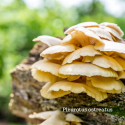
Oyster Mushroom (Pleurotus ostreatus)
The oyster mushroom is one of the best-known and most interesting species for anyone starting out in mushroom growing.
It's adapted to cool temperatures and, under favorable conditions, fruits mainly during autumn, winter and spring.
An oyster mushroom bed is designed to produce roughly from September through May, making the most of the cool, mild season.
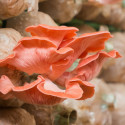
Pink Oyster Mushroom (Pleurotus djamor)
The pink oyster mushroom brings a particularly interesting trait: as a thermophilic species, it's adapted to high temperatures. Its fruiting is concentrated in the height of summer.
This makes it a good complement to the common oyster mushroom, extending production into the warmer months. In our experience, it can fruit at ambient temperatures between 25 and 35 °C.
Together, these two beds illustrate one of the most interesting principles of outdoor mushroom growing: it's not just about growing mushrooms, but about designing a production calendar that follows the seasons.
Other species worth exploring for this type of cultivation include wine cap mushroom (Stropharia rugosoannulata), enoki (Flammulina velutipes), straw mushroom (Volvariella volvacea) and phoenix oyster mushroom (Pleurotus pulmonarius).

A Crop That Can Last for Years
One of the great appeals of mushroom beds is that they don't necessarily have to be a single-cycle crop.
When the substrate is right, the mycelium takes hold properly, and the surroundings offer favorable conditions, a bed can keep producing for several years.
That completely changes the perspective compared with other growing systems.
We're not simply talking about preparing a substrate, getting one or two harvests, and starting over. We're creating a living, productive structure that evolves over time.
Managing it becomes a matter of observing, understanding and accompanying the system.
- When does it produce?
- When does it stop producing?
- How does it respond to rain?
- How does the substrate evolve?
- What's its relationship with shade and the surrounding vegetation?
In many ways, this ongoing observation is what makes outdoor mushroom growing such an interesting experience.
An Opportunity for Market Growers
For a professional grower, adding mushrooms to the system can be an excellent opportunity to diversify.
Mushroom beds can make use of spaces that aren't always well suited to certain vegetables: shady areas, margins, spots under trees or transition zones.
They also make it possible to set new production calendars and round out what the garden usually offers.
It's not necessarily about replacing one crop with another, but about asking:
What else can we grow in this space?
That question is especially relevant at a time when we're looking for agricultural systems that are more efficient, more diverse and better aligned with the principles of a circular economy.
Cultivation Beds and Productive Landscaping
Cultivation beds don't have to be limited to vegetable gardens. A garden can also become a food-producing space.
In landscaping projects, edible gardens, educational farms, community gardens or agroecological spaces, mushrooms can be integrated naturally into the design.
Picture shaded areas with plants, fruit trees, herbs and mushroom cultivation beds: spaces where production, biodiversity and landscape stop being separate concepts.
For landscapers and gardeners, this opens up a very interesting way to bring mushroom growing into the design of living, productive spaces.
Growing Mushrooms Is Also Growing Autonomy
Outdoor mushroom growing invites us to look at agricultural spaces and gardens from a new perspective.
It shows us that mushrooms don't have to be grown in a climate-controlled room or a complex facility. They can also be part of a vegetable garden, a garden or a farm.
And above all, it reminds us of something essential: food production can be far more diverse and closer to home than we usually imagine.
Bringing mushrooms into our production system means exploring new ways of making the most of available resources, diversifying harvests, moving toward self-sufficiency, and reconnecting more directly with the natural cycles around us.
That's why mushroom beds can be much more than just a growing technique: they invite us to become one more piece of the garden, the yard and the outdoor space, with an outlook that's more productive, more resilient, and geared toward diversifying the species we grow.