
Differences between powder and medicinal mushroom extracts
In the market for medicinal mushrooms there is widespread confusion among the different available formats: dehydrated mushroom powders, aqueous extracts, alcoholic extracts, dry extracts, and hydroalcoholic extracts. This apparent complexity actually conceals fundamental differences that determine bioavailability, the concentration of active compounds, and ultimately, the therapeutic efficacy of the product. Understanding these differences is essential for making informed decisions about which type of medicinal mushroom supplement to choose for each of us.
The chitin problem: Why isn't grinding the mushroom enough?
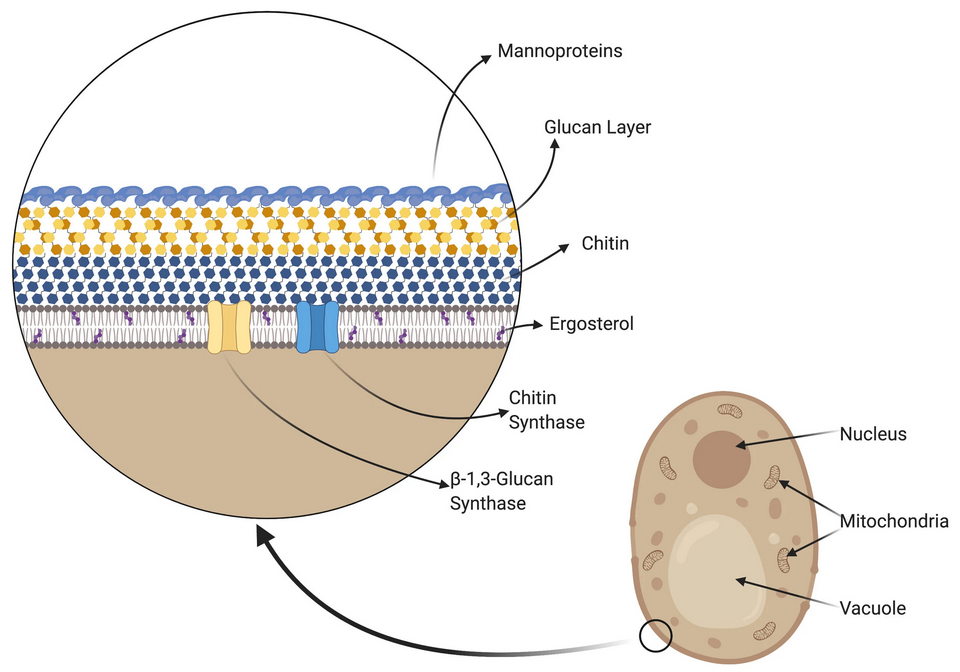
Mushrooms are not plants (this seems logical and is common knowledge today, but not long ago mushrooms were classified within the plant kingdom); therefore their biology is different and this is crucial to understand: their cells don't have cellulose, but are protected by walls of chitin, the same resistant material that forms the shell of insects and crustaceans. This presents three fundamental biological barriers:
- Structural strength: Chitin is an extremely hard fiber designed to protect; our digestion is not prepared to digest it.
- Lack of enzymes: The human stomach lacks the necessary enzyme (chitinase) to break down these cell walls efficiently.
- The "chest effect": The active compounds (beta-glucans, triterpenes) are trapped inside these walls. If we don't break the chest, we can't access the treasure.
Therefore, when we consume dehydrated mushrooms in powder form (micronized), we are mainly ingesting indigestible fiber. Although it has some nutritional value, the bioavailability of the active compounds (medicinal) is very low because our body cannot extract them.
Simple mushroom extraction: water or alcohol
To release the bioactive compounds trapped within fungal cells, an extraction process is necessary. The most basic methods use a single solvent, either hot water or alcohol, to break down the cell walls and solubilize the active compounds.
Aqueous extraction, traditionally employed in infusions and decoctions of Oriental medicine, uses hot water at temperatures close to boiling for prolonged periods. This method is effective for extracting water-soluble compounds, mainly polysaccharides such as beta-glucans, which are responsible for much of the immunomodulatory properties of medicinal mushrooms. Beta-glucans are hydrophilic molecules that dissolve well in water, and aqueous extraction at elevated temperature breaks the chitin chains sufficiently to release and extract them.
On the other hand, alcoholic extraction uses ethanol as a solvent to extract fat-soluble compounds or those poorly soluble in water. This method is particularly effective for obtaining triterpenes, sterols, alkaloids, and phenolic compounds. In the case of Reishi, for example, triterpenes are responsible for its adaptogenic, anti-inflammatory, and hepatoprotective properties. These compounds have a chemical nature that makes them practically insoluble in water, so an aqueous extraction does not capture them significantly.
The fundamental limitation of simple extraction is that each solvent captures only part of the spectrum of bioactive compounds. An exclusively aqueous extract will lack triterpenes, while a purely alcoholic extract will lose much of the polysaccharides. This limitation has led to the development of more sophisticated methods.
Double extraction (hydroalcoholic extraction)
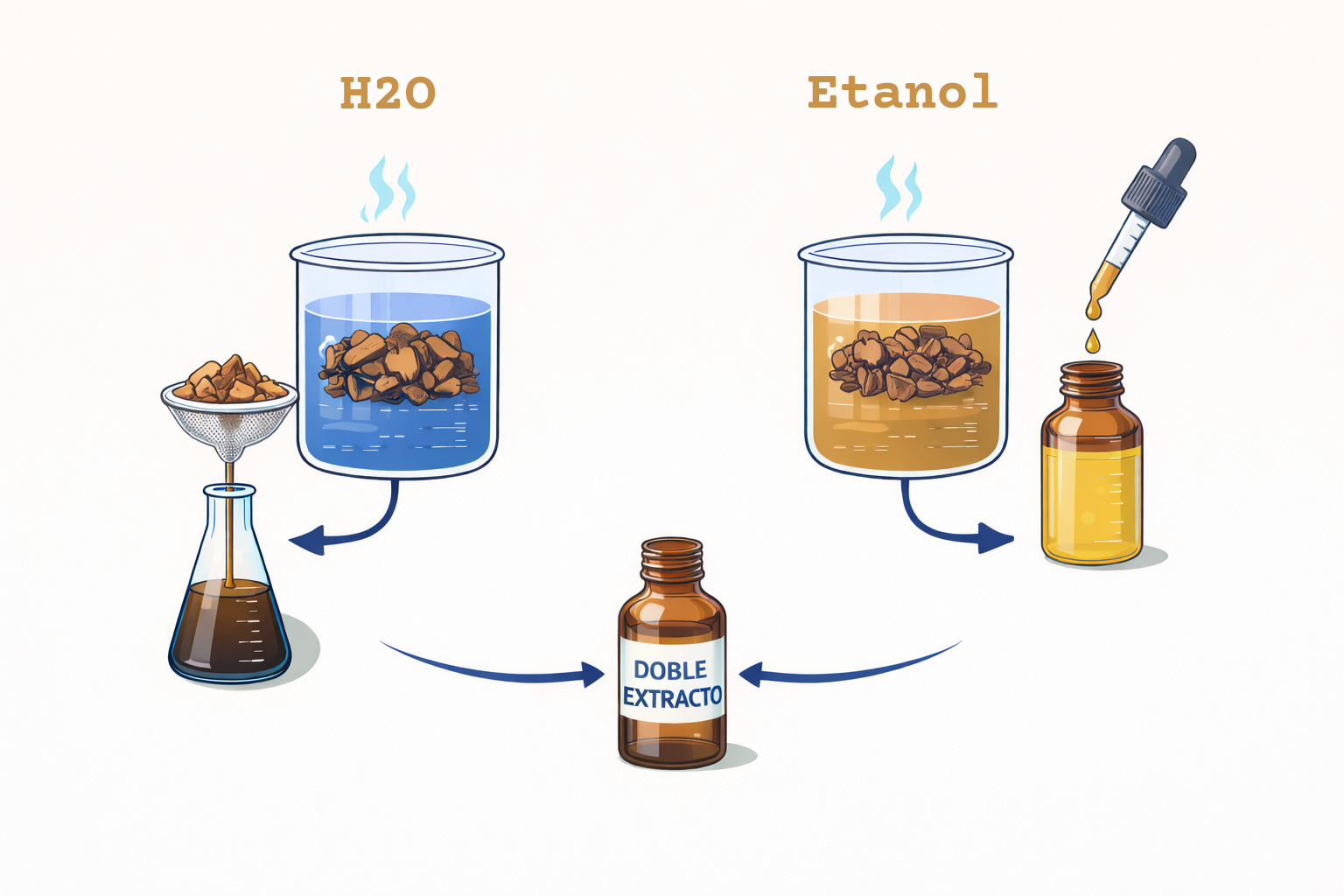
Double extraction, also known as dual extraction or hydroalcoholic extraction, combines both methods in a sequential process that captures both water-soluble and fat-soluble compounds. This is the method we use at Boscum to ensure that our extracts contain the most complete possible spectrum of active compounds.
At Boscum we use the hydroalcoholic extraction method to optimize the bioavailability of active compounds.
The process begins with aqueous extraction at controlled temperature near boiling. The raw material, that is the fruiting body of the fungus, undergoes a maceration process in hot water for several hours. This step breaks down the chitin cell walls and allows polysaccharides, including beta-glucans, to dissolve in the water. After this process, the material is filtered and the resulting liquid is preserved, containing the concentrated water-soluble compounds.
Next, the remaining material, still rich in fat-soluble compounds that were not extracted with water, undergoes alcoholic extraction. High-proof ethanol is used which, being an organic solvent, is capable of dissolving triterpenes, sterols, and other lipophilic compounds. This second extract is likewise filtered, obtaining an alcoholic solution concentrated in these active compounds.
The final phase of the process consists of merging both extracts in a determined proportion. At Boscum, after multiple tests and analyses, we have optimized this proportion for each type of mushroom, ensuring that the final extract contains the maximum concentration of all compounds of interest. The result is a hydroalcoholic extract that represents the complete spectrum of bioactives from the mushroom.
Summary: What are you really consuming?
| Format | What does it contain? | Bioavailability |
|---|---|---|
| Mushroom powder | Lots of fiber (chitin) and trapped active compounds. | Low |
| Infusion (Water) | Only water-soluble compounds (Beta-glucans). | Medium |
| Double Extract (Boscum) | Full spectrum: Beta-glucans + Triterpenes. | Very High |
How to interpret the concentration ratio on the label?
On medicinal mushroom supplement labels it is common to find indications such as 1:2, 5:1, 10:1, or 15:1. These numbers express the bioactive compound (extract)-raw material ratio, that is, the proportion between the amount of raw material used and the amount of final extract obtained.
A liquid extract with a 1:2 ratio means that to obtain 2 grams of final extract, 1 gram of dry raw material was used. In this case, the extraction process adds the weight of the solvents to the weight of the extracted active compounds. This is the format we use in our liquid hydroalcoholic extracts.
Conversely, a dry extract with a 10:1 ratio indicates that 10 grams of raw material were needed to produce 1 gram of dry extract. In this format, the solvents have been completely evaporated, leaving only the active compounds concentrated in powder form. Our Reishi capsules contain 10:1 dry extract obtained through double extraction, which guarantees high concentration in a convenient format to consume.

However, it is essential to understand that the concentration ratio, by itself, is not sufficient to evaluate the quality of an extract. A high ratio can be obtained simply by evaporating more solvent, without this necessarily implying a higher concentration of specific bioactive compounds. For this reason, at Boscum all our extracts are analyzed by independent reference laboratories, which quantify and certify the actual content of triterpenes, beta-glucans, and other specific markers.
Liquid extracts versus dry extracts: advantages of each format
Medicinal mushroom extracts can be presented in different physical formats, each with its own advantages in terms of absorption, stability, and ease of use.
- Hydroalcoholic liquid extracts, such as those we produce, offer several distinctive advantages. The first is sublingual absorption, a mechanism that allows active compounds to pass directly into the bloodstream through the mucous membranes of the mouth, bypassing the stomach and liver in the first phase of absorption. This not only accelerates the onset of action but also improves bioavailability by avoiding partial metabolization that can occur in the acidic environment of the stomach and our liver. Additionally, the liquid format facilitates dose customization. While a capsule contains a fixed amount of extract, with a liquid extract it is possible to adjust the dose drop by drop according to individual needs or the recommendations of a therapist. This flexibility is particularly valuable when working with adaptogenic formulas that may require gradual adjustments.
- Dry extracts in capsules, for their part, offer maximum concentration in minimum volume. A 500 mg capsule of 10:1 dry extract represents the equivalent of 5 grams of raw material, all in a compact and easy-to-transport format. For people who prefer to avoid the characteristic taste of medicinal mushrooms or who seek maximum ease of use, this format is ideal. Capsules also have the advantage of standardized and precise dosing, eliminating any margin of error in measurement.
Other factors that influence extract quality
The extraction method is only one of the factors that determine the final quality of a medicinal mushroom extract. Other equally crucial elements include the quality of the raw material, growing conditions, the part of the mushroom used, and quality control of the final product.
At Boscum we work with medicinal mushrooms grown under organic certification in our own facilities in La Garrotxa with zero-kilometer raw material. This total control over cultivation allows us to ensure that the mushrooms grow on substrates of maximum quality, free from pesticides and heavy metals, and that they are harvested at the optimal moment of maturation, when the concentration of active compounds is maximum.
We exclusively use the fruiting body of mushrooms, not mycelium grown on grain. Although some manufacturers use mycelial biomass grown on cereal substrates, studies have shown that this material may contain more starch from the substrate than fungal active compounds, diluting the potency of the final extract. The fruiting body, on the other hand, is the part of the mushroom with the highest concentration of specific bioactive compounds.
There is a notable exception to this rule: Chaga. Unlike other medicinal mushrooms, in the case of Chaga the active compounds develop primarily in the mycelial mass that forms the sclerotium, the black protrusion that grows on birch trees. This particularity of Chaga demonstrates that there is no single approach applicable to all species, and that specific mycological knowledge is essential to optimize the processing of each mushroom.
The importance of packaging for proper preservation
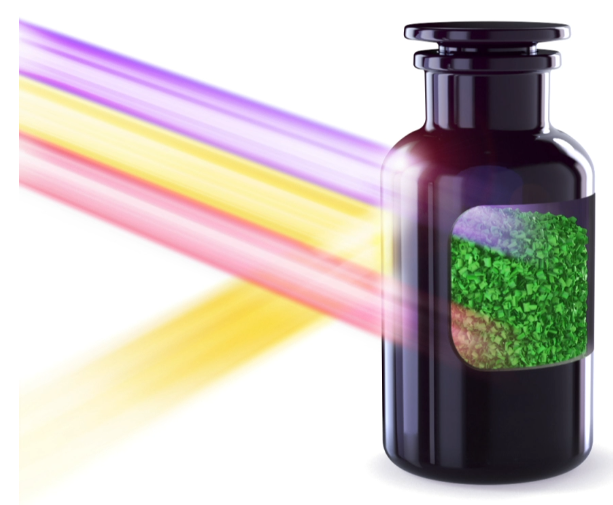
A maximum quality extract can degrade rapidly if not preserved under appropriate conditions. The active compounds in medicinal mushrooms, especially triterpenes and phenolic compounds, are susceptible to oxidation when exposed to light and oxygen.
For this reason, at Boscum we have chosen MIRON biophotonic glass containers manufactured in the Netherlands. This type of dark violet glass has unique light filtration properties. While transparent or amber glass allows radiation to pass through that can degrade sensitive compounds, MIRON glass blocks the entire visible light spectrum except violet, ultraviolet, and infrared radiation. Paradoxically, these specific radiations do not degrade active compounds but rather, according to photobiological studies, can prolong their stability.
Additionally, our containers are vacuum-sealed after filling, eliminating oxygen from the headspace and minimizing oxidation during storage. This combination of biophotonic glass and vacuum sealing guarantees that the extract maintains its therapeutic properties intact until the moment of consumption.
Main sources
- Lemieszek MK, Langner E, Kaczor J, et al. (2011). Anticancer effects of fraction isolated from fruiting bodies of Chaga medicinal mushroom, Inonotus obliquus. International Journal of Medicinal Mushrooms, 13(2):131-143.
- Smith JE, Rowan NJ, Sullivan R. (2002). Medicinal Mushrooms: Their therapeutic properties and current medical usage with special emphasis on cancer treatments. Cancer Research UK.
- Wasser SP. (2002). Medicinal mushrooms as a source of antitumor and immunomodulating polysaccharides
- Guthmann, J. (2024) Heilende Pilze Weltweit: Beschreibung - Inhaltsstoffe - Wirkung. Wiebelsheim: Quelle & Meyer Verlag.