Can Fungi Help Us Prevent Forest Fires?
When we think about forest fire prevention, we usually talk about brush clearing, extensive livestock grazing, prescribed burns or forest management. But there's another actor, much less visible, that could play an important role in the resilience of our forests: fungi.
Fungi are the great recyclers of forest ecosystems. Through mycelium (the underground network that makes up most of the fungus), they break down dead wood, fallen branches and plant matter accumulated on the ground, transforming it into nutrients available for the rest of the forest's life.
And here a fascinating question arises:
if we encourage the activity of decomposer fungi, could we reduce part of the fuel available for major forest fires?
Fungi: the forest's invisible managers
Saprophytic species such as Pleurotus ostreatus, Pleurotus pulmonarius, Trametes versicolor or Phanerochaete chrysosporium are able to break down lignin and cellulose thanks to extraordinary enzymes such as laccases and peroxidases.
These organisms have spent millions of years doing essential work: turning dead wood into soil, fertility and new life.
Without fungi, forests would be immense graveyards of accumulated logs.
In a way, fungi are the silent firefighters of forest ecosystems.
What's more, their role goes far beyond decomposition. Soils rich in fungal activity retain water better, maintain a more stable structure and are more resilient to periods of drought, a particularly relevant aspect in today's climate context.
The Peaks to Prairie project
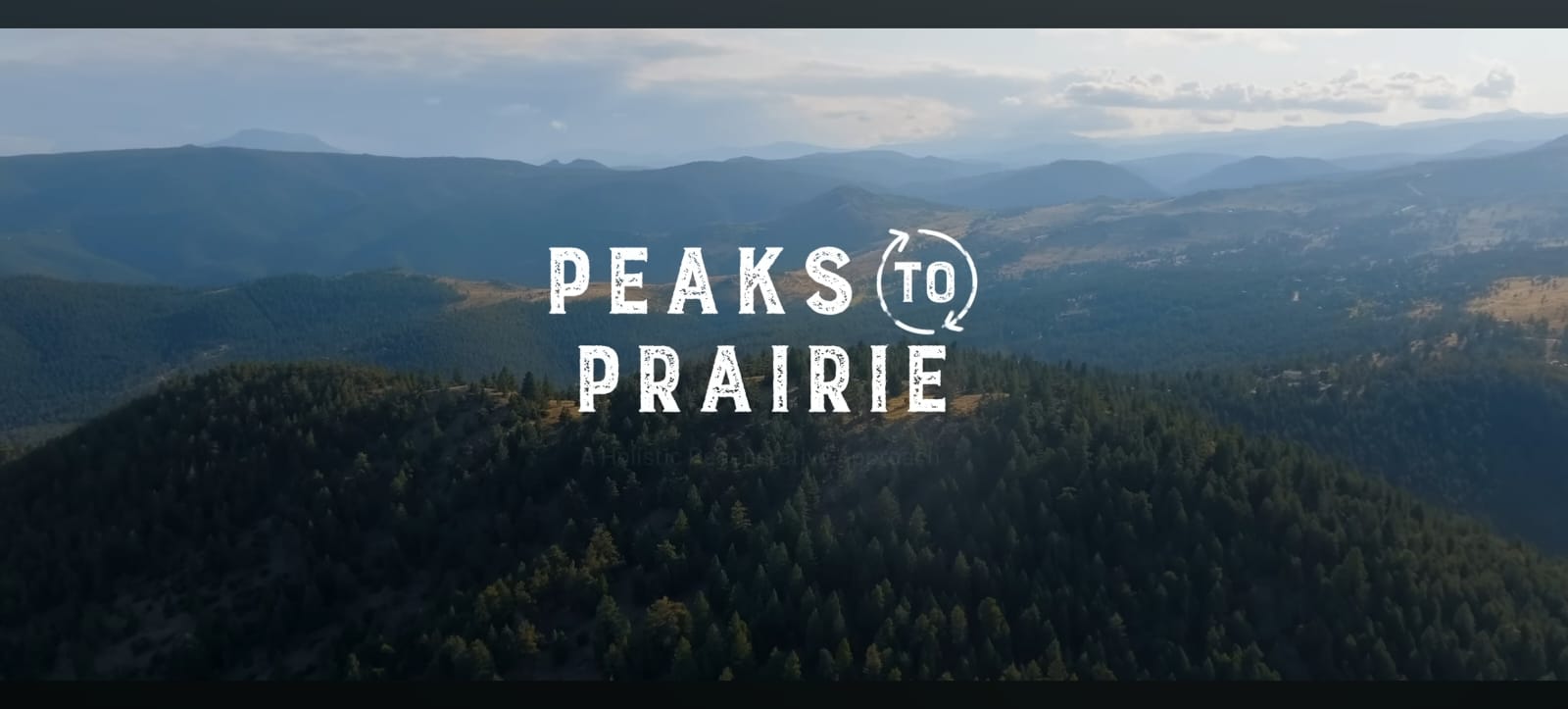
This potential is precisely one of the ideas explored by the documentary short film Peaks to Prairie, produced by Free Range Films and screened during the Fungi Film Fest, a festival of fungus themed short films that we were fortunate to co-organize at the Zumzeig cinema in Barcelona in 2025.
The documentary follows a project developed in Colorado, where the biomass generated by fire prevention work and forest thinning is turned into wood chips and inoculated with decomposer fungi.
The goal is not simply to eliminate forest waste, but to turn that material into a resource capable of regenerating degraded agricultural soils and returning nutrients to the land.
What used to be considered waste becomes a tool for restoring ecosystems.
It's a different way of understanding forest management: not as a constant fight against nature, but as a collaboration with processes that nature has spent millions of years perfecting.
But the fire problem isn't only ecological
We often talk about fires as if they were a purely natural phenomenon.
They're not.
Major fires are also the result of a landscape that has been progressively abandoned.
For generations, shepherds, farmers, charcoal burners, woodcutters and foresters maintained mosaic landscapes, with open forests, cultivated fields and grazing areas that acted as true natural firebreaks.
Those landscapes didn't exist by chance.
They existed because people made a living caring for them.
Today many of these trades are disappearing.
Not because they're no longer needed, but because they've often become economically unviable.
And on top of this difficulty, all too often, growing bureaucracy makes active land management enormously difficult.
Permits, paperwork and administrative processes that can drag on for months or years while fuel keeps building up in the forests.
It's paradoxical that at a time when almost everyone agrees on the need to manage forests, many of the people who could dedicate their lives to it face more and more obstacles to actually doing the work.
Perhaps the question isn't just how we'll put out future fires.
Perhaps the question is who will take care of the forests so those fires never happen in the first place.
A new climate, new risks
On top of all this, there's a reality that's hard to ignore: our summers are no longer what they were thirty years ago.
Temperatures are rising, heat waves are becoming more frequent and prolonged, drought periods are lengthening, and forest humidity is decreasing year after year.
Mediterranean forests have always coexisted with fire.
What's changing is the intensity, speed and destructive power of the fires we see today.
There are more and more days with conditions capable of generating major forest fires that overwhelm the capacity of emergency crews.
And despite this, collective awareness of this risk often remains limited.
We keep thinking of fires as occasional summer events, when in reality they're the visible consequence of a problem that builds up over decades.
Prevention doesn't start when smoke appears on the horizon.
It starts much earlier.
It starts with forest management, with support for the trades that care for the land, with the recovery of agroforestry mosaics, with political decisions, and also with our collective ability to understand that the landscape we want to preserve needs to be inhabited, worked and cared for.
Fungi don't replace people
Fungi can be an extraordinary tool.
They can speed up biomass decomposition, regenerate soils, increase water retention and contribute to more resilient ecosystems.
But they will never replace the work of the people who live in and care for the land.
Fire prevention probably won't come from a single technological solution.
It will come from a combination of ecological knowledge, forest management, pastoralism, regenerative agriculture and living rural communities.
Fungi are part of this conversation.
But so are the shepherds who clear paths with their flocks, the foresters who manage the woods, and the people who choose to stay on the land and care for it.
Perhaps the best strategy against major fires isn't just investing more resources in putting them out.
Perhaps it's investing again in the people who, day after day, keep those fires from ever starting.
And perhaps it's also starting to look a little more closely at what's beneath our feet.
Because under the forest floor there's an invisible network that has spent hundreds of millions of years connecting, recycling and sustaining life.
Fungi won't put out fires for us.
But maybe they can help us remember something essential:
that the health of forests depends as much on the invisible organisms that inhabit them as on the people willing to care for them.
You can watch the full short film "Peaks to Prairie", produced by Free Range Films, at the following LINK. We hope it inspires you as much as it inspired us!