
What is the wood wide web?
For decades, the popular image of the forest has been rooted in competition: trees fighting each other for light, water and nutrients in a Darwinian battle for survival. However, modern ecology has revealed a far more complex story. Forests also function as deeply interconnected systems, where much of the most fascinating interaction occurs beneath our feet. This is the context in which the term wood wide web has emerged — an expression describing the underground network formed by roots and mycorrhizal fungi that connects multiple plants within the same ecosystem.
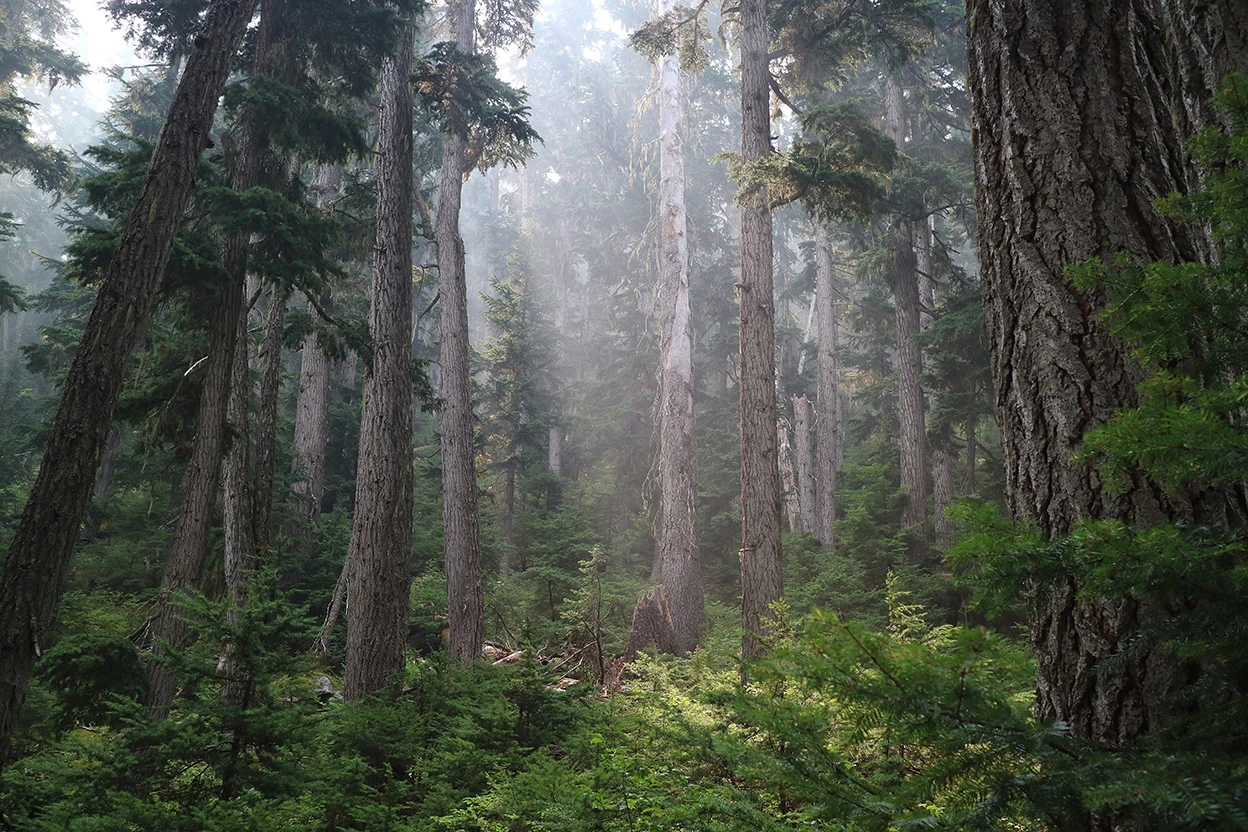
The wood wide web is not an intentionally designed structure, nor an "intelligent" system in the human sense, but rather the result of an evolutionarily ancient symbiosis between plants and fungi, with over 400 million years of coevolution. Mycorrhizae are mutualistic associations in which fungi attach to or penetrate roots and develop an intricate network of hyphae that spreads through the soil, exponentially extending the reach of plants' root systems.
Mycorrhizal networks: an underground nutrient highway
In most forest ecosystems, trees critically depend on mycorrhizal fungi to access nutrients that would be difficult or impossible to obtain directly. The fungal hyphae — microscopic filaments just a few micrometres in diameter — act as ultra-thin extensions capable of exploring soil micropores that are completely inaccessible to roots. Through this fungal network, the tree can absorb phosphorus, nitrogen, essential micronutrients and water far more efficiently.
In return, the tree transfers sugars and other carbon-based compounds produced through photosynthesis to the fungus, dedicating up to 30% of its fixed carbon to maintaining this association. In ecological terms, this is a bidirectional exchange of resources that benefits both parties and can decisively influence growth, resistance to pathogens and the overall stability of the ecosystem.
What makes this truly fascinating is that a single fungal mycelium can simultaneously connect with dozens or even hundreds of trees, forming what the scientific literature calls common mycorrhizal networks. These networks create physical pathways for the potential movement of chemical compounds, molecular signals and nutrients between individuals that would otherwise appear to be entirely independent organisms.
Time-lapse of ectomycorrhizal growth on pine roots, showing how fungal hyphae completely envelop the roots, forming the symbiosis known as mycorrhiza. Video: © Wim van Egmond (2021). Available on Vimeo. More information: wimvanegmond.com
How do trees "communicate" through the soil?
When we talk about "communication" between trees, it is essential to clarify that we are not referring to a conscious or intentional exchange, but to complex biochemical processes: organic molecules, hormonal signals and nutrients that can flow through these fungal connections. Several controlled experiments have used labelled radioactive isotopes (such as carbon-14 or carbon-13) to track the movement of carbon between plants connected by the same mycorrhizal network, observing that a fraction of the carbon fixed photosynthetically by one tree can end up in the roots and tissues of neighbouring trees associated with the same network.
Beyond nutrients, some pioneering studies have suggested that mycorrhizal networks may transport alarm signals related to biotic stress. For instance, when a tree is attacked by herbivorous insects or pathogens, it can trigger the production of secondary defensive compounds, and plants connected through the mycorrhizal network may detect these signals and initiate preventive physiological changes before being directly attacked, preparing their defences in advance.[3]
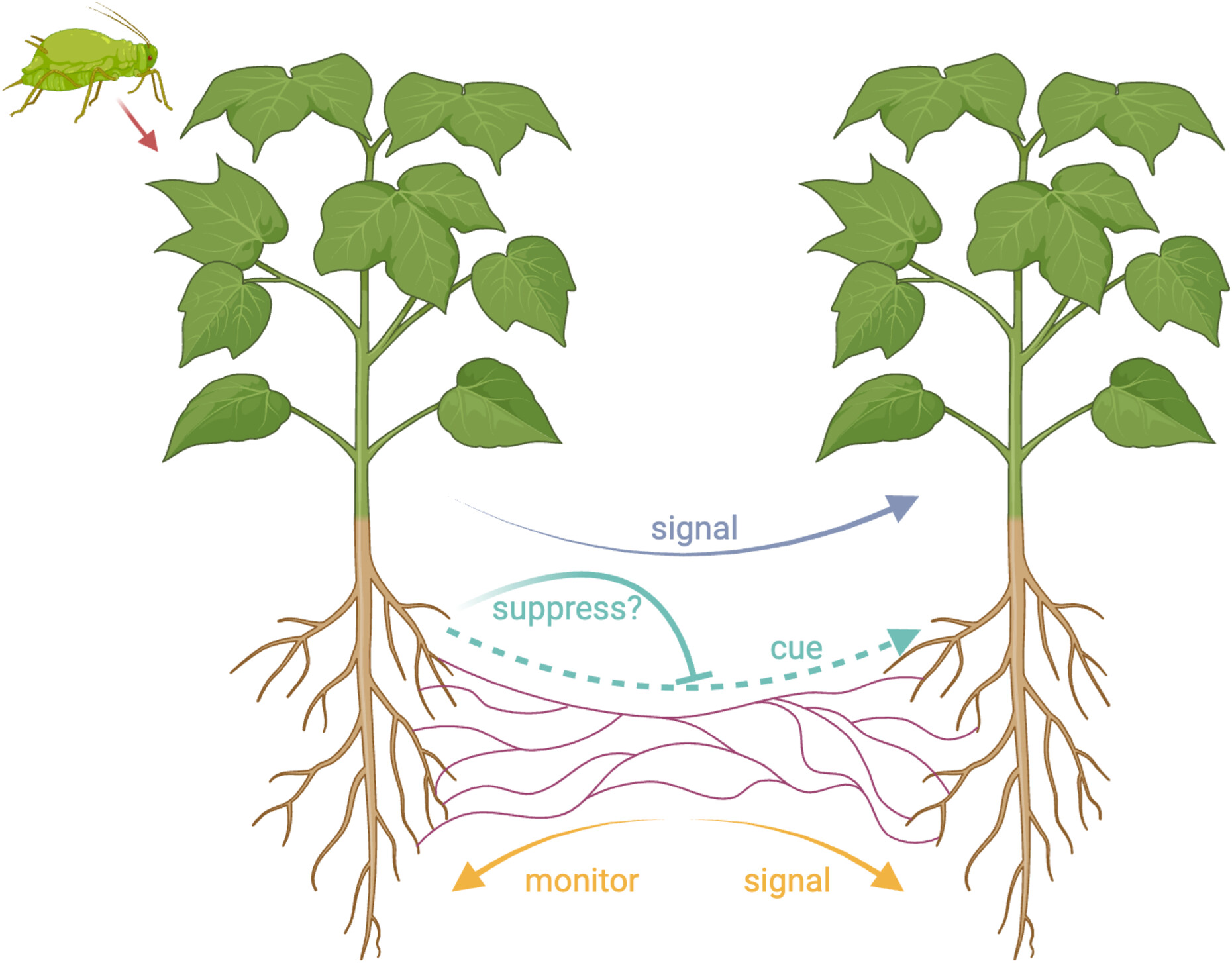 Conceptual diagram of information transfer in a common mycorrhizal network: a plant under attack (e.g., by aphids) could induce defensive responses in another connected plant. The model proposes three hypotheses: (blue) active signalling by the attacked plant; (cyan) incidental signal transfer or "cues"; and (orange) detection and signalling mediated by the fungal network itself. [6]
This type of interaction does not necessarily imply altruism in the classical evolutionary sense. It can be better understood as an emergent phenomenon in which the survival of the whole — the forest as a superorganism — indirectly favours the survival of the connected individuals, particularly in dense forests where the fate of one tree is intimately linked to the stability and resilience of the entire ecosystem.
Mother trees and resource redistribution: central nodes of the network?
One of the most well-known and widely publicised concepts associated with the wood wide web is that of so-called "mother trees" (mother trees): large, old, deeply established trees that, by being simultaneously connected to multiple young and adult individuals, may act as central nodes or "hubs" within the architecture of the network. The hypothesis proposes that these ancient trees can facilitate young trees' and seedlings' access to critical resources such as carbon, water and nutrients, especially in unfavourable microsites with little light or poor soils.
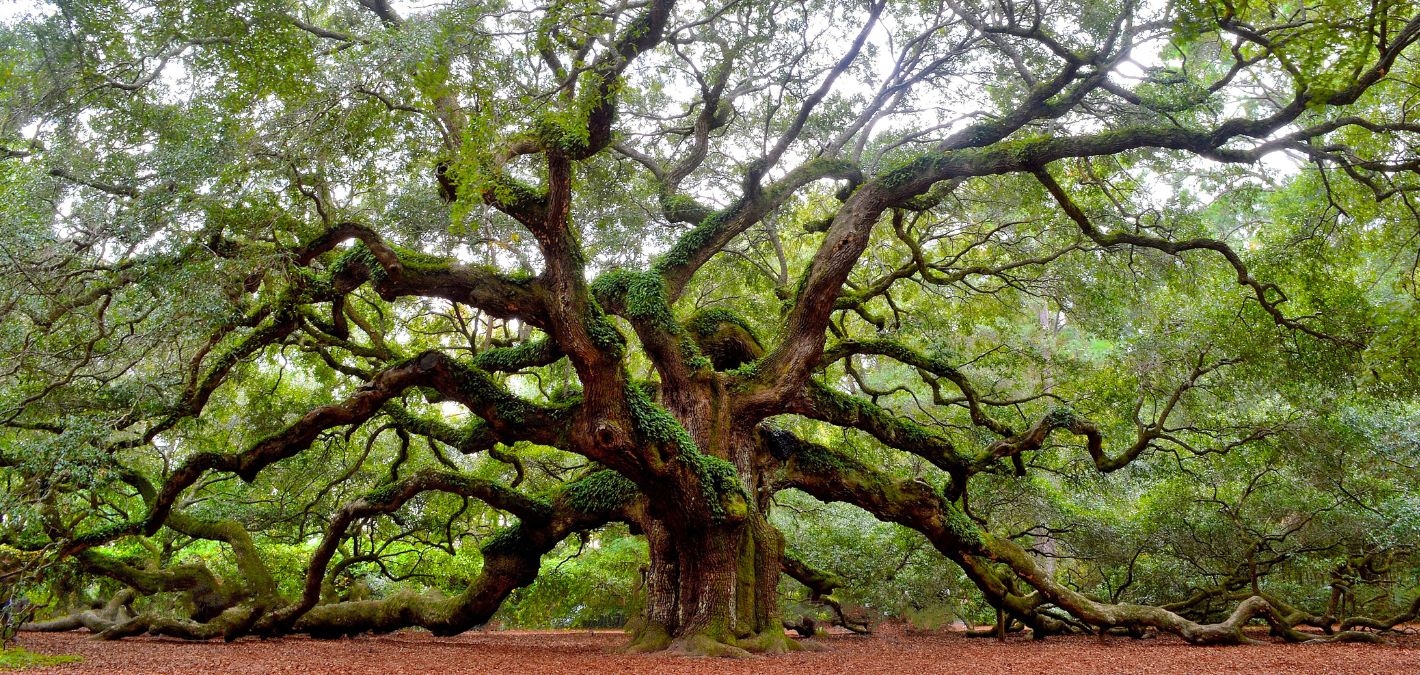
According to this interpretation, the mycorrhizal network would function as a decentralised resource redistribution system that improves the demographic resilience of the forest, promoting the successful establishment of new generations. However, it is important to stress that the actual magnitude of these resource flows, their preferential directionality and their frequency under natural conditions vary considerably depending on the plant species, the type of symbiotic fungus, the soil structure and the specific environmental conditions of each ecosystem.
What does science actually say?
The wood wide web has been popularised in documentaries, bestselling books and media as a kind of "natural internet" or "collective mind of the forest", where trees "actively care" for their offspring and "generously share" resources with needy neighbours. These narratives are pedagogically appealing and have captured the public's imagination, but can be scientifically misleading if interpreted literally.
In recent years, part of the scientific community has expressed concern about the possible overinterpretation of the scope and magnitude of tree cooperation and net resource transfer. A recent paper published in PNAS (2024) notes that, while functional common mycorrhizal networks exist and the movement of carbon and other compounds between connected plants has been demonstrated, evidence of substantial and ecologically decisive net transfers between adult trees under natural conditions remains limited and highly dependent on the experimental context.[5]
Similarly, an analysis in Nature (2024) underlines that detecting labelled carbon in a neighbouring tree does not necessarily imply a directed "donation" or an adaptive mechanism of cooperation. In many cases, the movement may respond to physiological gradients, differences in metabolic demand or the symbiotic fungus's own dynamics. The actual magnitude of these flows, their preferential directionality and their impact on individual fitness continue to be the subject of rigorous research.[6]
The debate has extended beyond the strictly academic realm. A recent article in The Guardian (2024) covers the controversy surrounding the "mother tree" metaphor and warns of the risks of anthropomorphising complex ecological processes. Some researchers point out that describing forests as "solidary" systems can oversimplify dynamics in which cooperation, competition, parasitism and asymmetrical relationships coexist.[7]
The wood wide web must therefore be understood as a real, empirically documented and ecologically relevant phenomenon, but one whose exact dynamics, spatiotemporal variability, evolutionary significance and adaptive consequences remain active areas of rigorous scientific research and legitimate academic debate.
Why does this concept transform our vision of the forest?
Beyond the technical details, methodological controversies and scientific nuances, the wood wide web is conceptually important because it challenges a reductionist and excessively competitive vision of the forest. It shows us that we are not simply looking at a collection of individual trees competing selfishly for limited resources, but at a highly interdependent ecological system in which microorganisms such as mycorrhizal fungi, rhizospheric bacteria and other components of the soil microbiome play essential roles in primary productivity, community stability, biogeochemical cycles, natural regeneration and resistance to environmental disturbances.
This ecosystem perspective has direct, concrete and urgent implications for forest management and conservation policies. Intensive logging without ecological consideration, physical compaction and degradation of soil by heavy machinery, excessive use of agrochemicals, fungicides and synthetic fertilisers, or landscape fragmentation can severely damage underground fungal communities, altering or destroying invisible mycorrhizal networks that may have taken decades — or even centuries — to establish and that are extremely difficult to restore artificially.
In other words, protecting a forest does not simply mean preserving the trunks, canopies and aerial biomass visible above the surface. It necessarily means also protecting underground life: the invisible but fundamental web of fungi, bacteria, archaea, invertebrates and other soil microorganisms that sustains the ecological health, productivity and long-term resilience of the entire forest ecosystem.
It is flora, fauna and funga that we need to protect. For a long time, legal frameworks and environmental policies have explicitly recognised only plants and animals, leaving fungi in a conceptually ambiguous zone despite their structural role in terrestrial ecosystems.
Chilean mycologist Giuliana Furci has been one of the key drivers in raising public and scientific awareness of this frequently overlooked "third kingdom" in conservation policies. Through the Fungi Foundation, she promoted a conceptual revision that had a historic impact: Chile became the first country in the world to adapt legal texts to explicitly recognise fungi — funga — within its environmental protection framework.
This symbolic and legal shift reflects a profound transformation in our ecological consciousness. If we accept that ecosystems function as complex networks in which funga plays a structural role, then conservation must explicitly integrate flora, fauna and funga as inseparable components. In a context of climate crisis, biodiversity loss and soil degradation, understanding — and protecting — these invisible networks ceases to be a scientific curiosity and becomes an urgent necessity.
Sources and references
- [1] Smithsonian Gardens. The Wood Wide Web. https://gardens.si.edu/exhibitions/traveling/habitat/the-wood-wide-web/
- [2] BBC Science Focus. Mycorrhizal networks: The Wood Wide Web. https://www.sciencefocus.com/nature/mycorrhizal-networks-wood-wide-web
- [3] PBS NOVA. The Wood Wide Web. https://www.pbs.org/wgbh/nova/nature/wood-wide-web.html
- [4] Phys.org. Study challenges popular ideas about the 'wood wide web'. https://phys.org/news/2024-12-wood-wide-web-tree-nutrient.html
- [5] Scott, T.W., Kiers, E.T. and West, S.A. (2025) 'The evolution of signaling and monitoring in plant–fungal networks', Proceedings of the National Academy of Sciences, 122(4). doi:10.1073/pnas.2420701122.
- [6] Irwin, A. (2024) The 'mother tree' idea is everywhere - but how much of it is real?, Nature News. Available at: https://www.nature.com/articles/d41586-024-00893-0 (Accessed: 19 February 2026).
- [7] Mother trees and socialist forests: Is the 'wood-wide web' a fantasy? (2024) The Guardian. Available at: https://www.theguardian.com/environment/2024/apr/23/mother-trees-and-socialist-forests-is-the-wood-wide-web-a-fantasy (Accessed: 19 February 2026).